Structural Drying in Banning, CA
Surface dry is not dry. In Banning, the drying team dries the framing, subfloor, slab and wall cavities to the IICRC S500 standard, with daily readings logged until the structure matches a dry reference, 24/7.
(888) 563-9619Need walls dried? Call now- Daily moisture logs
- LGR and desiccant drying
- Dry reference readings
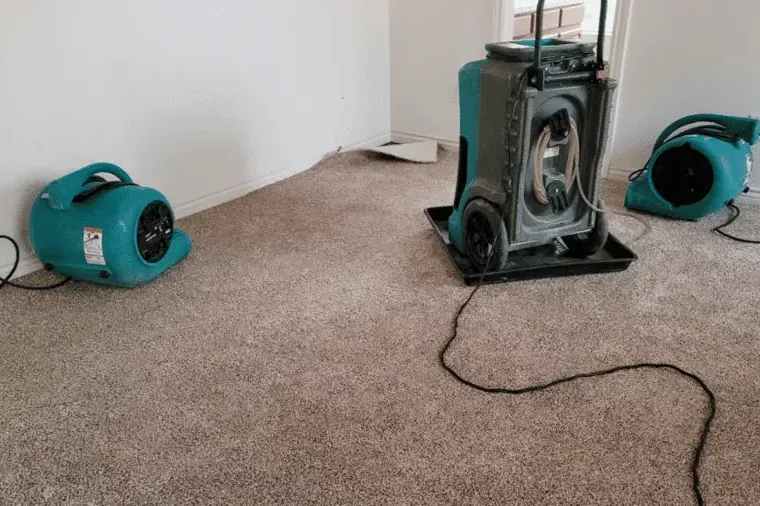
What to do the moment you find wet walls and floors
- Step 1Keep windows closed
Close windows and doors so the dehumidifiers work on the house air, not the outdoors.
- Step 2Leave the equipment running
Keep air movers and dehumidifiers on around the clock, even at night.
- Step 3Do not move the air movers
Leave equipment where the drying team set it; each one is aimed at a wet material.
- Step 4Keep the HVAC as set
Run the heating or cooling at the setting the drying team leaves for the best drying conditions.
Structural drying is the part of a dry-out that nobody sees: getting water out of the framing, the subfloor, the concrete slab and the inside of the walls after the floor looks dry. In Banning, the dry summer air of the San Gorgonio Pass makes rooms feel dry fast, but drywall, bottom plates and concrete hold water long after the surface does. Readings, not appearances, decide when a structure is dry.
What does structural drying cost in Banning, CA?
Structural drying typically runs $1,200 to $9,000, set by the class of the loss, the square footage, the material class and the number of equipment days. A Class 1 room sits at the low end; Class 4 hardwood or concrete over several rooms sits at the high end.
- Air movers and one LGR
- Daily readings for three to four days
- Baseboards off for wall drying
- Ceiling and wall cavity drying
- Several LGR dehumidifiers
- Psychrometric logs for the claim
- Desiccant dehumidification
- Floor mats on hardwood or slab
- Extended equipment days
The drivers are the water category, the square footage, the material class and how fast drying started. For a planning range, try the water damage cost calculator.
How structural drying is handled in Banning
- 1
Dry reference and map
The tech who does the walkthrough reads a dry reference in an unaffected room, then maps moisture in every wet material on a floor plan.
- 2
Set the equipment
The drying team sets air movers to each room's evaporation load and sizes LGR or desiccant dehumidifiers to the class of the loss.
- 3
Daily readings
Every day the team logs moisture, temperature and humidity, then moves or removes equipment as materials come into range.
- 4
Verify and document
The equipment comes out only when wet materials read within 2 to 4 points of the dry reference, and the logs go to the claim file.
The standard behind structural drying
IICRC S500, the industry drying standard
Class 1 to 4 sets air movers and dehumidifiers
Air movers, LGR dehumidifiers, desiccants, floor mats
Daily psychrometric logs to a dry reference
How the IICRC S500 standard sets up a Banning dry-out
The standard classes each loss by how much water the materials absorbed. Class 1 is a small, contained wetting; Class 2 is a whole room with carpet and wall bottoms; Class 3 is water from above that soaked ceilings and walls; Class 4 is dense material such as hardwood, plaster or concrete that holds water tightly. The class sets how many air movers and how much dehumidification each room needs.
- Air movers are set to the evaporation load of each room.
- LGR dehumidifiers pull water back out of the air; desiccants handle Class 4.
- Wall cavities get directed airflow through small openings or removed baseboards.
What the drying team measures every day
The tech who does the walkthrough takes a dry reference reading from an unaffected room, then logs moisture in every wet material and the temperature and humidity in every room each day. Those psychrometric logs show the adjuster the drying worked. The EPA flood cleanup advice explains why wet materials must dry quickly, and Ready.gov covers returning home after water damage.
When the equipment comes out
Equipment stays until wet materials read within 2 to 4 points of the dry reference. Older homes near Ramsey Street with plaster walls, and slab homes along Interstate 10 with laminate floors, often take longer than a carpet-only loss. Drying follows water extraction on almost every job, and a wet slab gets the steps on slab leak water damage.
Related water damage services
Structural drying around Banning
The restoration team covers ZIP 92220 from downtown and the Ramsey Street corridor to Banning Heights, the Gilman Ranch area and the homes along Interstate 10, plus Beaumont and Cabazon next door.
Structural Drying questions
What is structural drying?
Drying the framing, subfloor, slab and wall cavities, not just the surfaces, to readings set by the IICRC S500 standard.
How long does structural drying take in a Banning home?
Most Class 1 and 2 losses dry in three to five days. Class 3 ceilings and Class 4 hardwood, plaster or concrete take longer.
Why can't I just open the windows to dry the house?
Outdoor air can help a little in the dry pass climate, but closed rooms with dehumidifiers control humidity and dry dense materials far more reliably.
How do I know the house is really dry?
The drying log shows each wet material reading within 2 to 4 points of a dry reference taken in an unaffected room.
Is the noise and power use normal?
Yes. Air movers and dehumidifiers run around the clock and draw steady power; they come out as soon as readings allow.
Does insurance pay for structural drying?
Drying after a covered loss is usually part of the claim, and daily logs support it. Coverage depends on your policy, so it is worth checking with your own insurer.
What does structural drying cost?
Most jobs run $1,200 to $9,000. The drying time estimator gives a planning range for days.
The floor looks dry, but the walls and baseboards still read damp?
(888) 563-9619Ask about the drying readingsWet walls in a Banning home? Call now.
The drying team sets the equipment, logs readings every day and leaves only when the structure is verified dry.