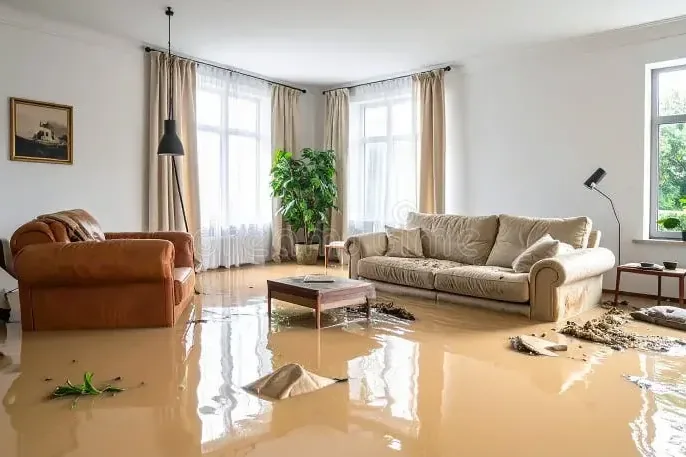
Calimesa Creek and the Wildwood Canyon Wash are the local water features that shape flood planning, and the city has a Stage III creek project aimed at easing flooding downtown. Even with those projects, a building that takes on water faces the same problem. Pumping out standing water is only half the job, and the drying that follows decides whether walls and floors can be saved.
Key takeaways
- After water is pumped out, wall cavities, subfloors and framing are still wet and must be dried with measured equipment.
- Moisture readings, not appearance, show when a building is dry.
- Creek water carries silt and contamination, so porous materials are often removed instead of dried.
- Air movers and dehumidifiers work together, and closing doors and windows helps them.
- Starting drying early limits how much drywall, flooring and insulation has to be replaced.
The Local Flood Picture
The creek meanders in and out of Yucaipa and Calimesa, so the boundary between the two cities does not follow the county border exactly in places. County Line Road is the political boundary, and the Wildwood Canyon Wash is the historic divide.
The Riverside County Flood Control and Water Conservation District completed the Calimesa Channel Stage I and Stage II projects in 2002. The city then filed its environmental document for Stage III in April 2023.
What the Stage III Project Aims to Do
The Stage III plan includes a detention basin, channel improvements, a new storm drain in County Line Road and slope stability work. It aims for 100 year flood protection along County Line Road and Calimesa Creek, from 5th Street on the east to Interstate 10 on the west.
One goal is to eliminate flooding in the downtown area, including the Calimesa Fire Station, City Hall and the Downtown Business District.
- Detention basin to hold peak flows.
- Channel improvements along the creek.
- A new storm drain in County Line Road.
- Slope stability work.
Why Pumping Out Water Is Not Enough
Standing water is removed first, and water extraction equipment handles most of it. What remains is moisture in drywall, baseboards, flooring layers and the wood framing behind them.
If that moisture stays, drywall softens and flooring cups. The structure may look fine for a few days and then show stains, odor or warped trim.
How Drying Is Done
Drying is a measured process. A crew places air movers to push dry air across wet surfaces, and dehumidifiers pull the moisture out of the air so it does not settle back into the walls.
Opening the cavities
Where readings stay high, a lower strip of drywall may be cut away so air can reach the cavity and the framing behind it.
- Baseboards removed to vent the wall base.
- Flood cuts at a set height above the water line.
- Insulation removed and replaced.
Monitoring until dry
Readings are taken on each visit and compared to dry reference points in the same building. Equipment is moved as the wet areas change, and drying ends only when readings match normal.
What Gets Removed Instead of Dried
Creek water is not clean. It carries soil, debris and contamination, so some materials are removed even if they could technically be dried.
Carpet pad, insulation, particle board cabinets and soft drywall are typical examples. Solid wood, tile and concrete usually come through with cleaning and drying.
- Carpet pad and insulation: removed.
- Soft or crumbling drywall: removed.
- Solid wood framing: cleaned and dried.
- Tile and concrete: cleaned, disinfected and dried.
Homes and Shops Both Face the Same Steps
A downtown shop and a house on a larger lot follow the same sequence, though shops often need to reopen sooner. A storm and flood cleanup plan for a business sets the order of work around the doors and the stock.
The city had 10,026 residents counted in 2020, and many properties sit in the foothills where water can arrive from a slope instead of a street.
Reading the Moisture Numbers
A moisture meter gives a number for each spot it touches, and the number only means something when it is compared with a dry reference. A crew records readings in a dry part of the same building and uses them as the target.
Readings are taken in the same places on every visit, so a falling number shows the drying is working and a number that stalls shows that more material needs to be opened or removed.
- Dry reference readings taken first.
- Wet spots marked and photographed.
- Repeat readings at the same points each visit.
- Stalled areas opened or equipment moved.
Closed Doors and Windows
Drying equipment works best in a closed space. Doors and windows are kept shut so that humid outside air does not enter, and dehumidifiers can pull moisture from a fixed volume of air.
Heating or cooling the rooms to a steady temperature also speeds evaporation, because warm air holds more moisture than cool air.
Fans placed only to blow air around do not replace this process. The equipment is placed according to the shape of each room and the location of the wet materials.
Flooring That Can Be Saved
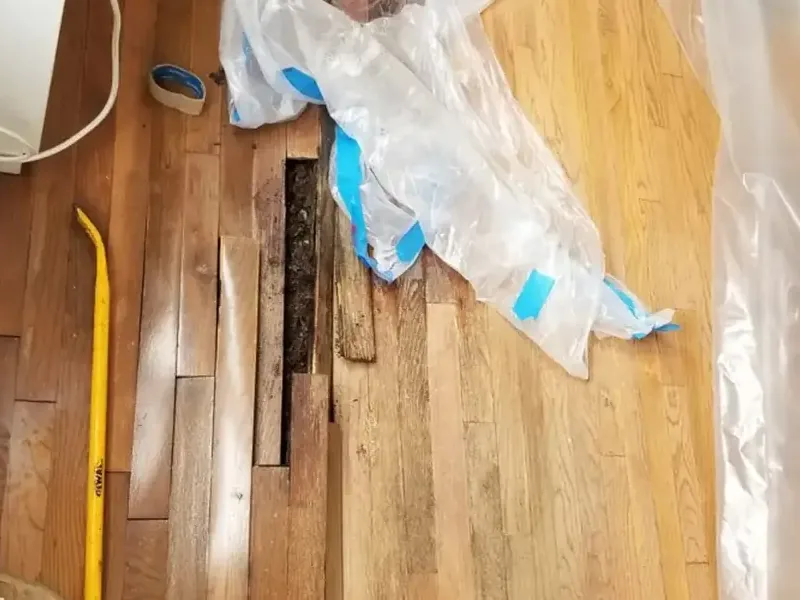
Tile and sealed concrete usually survive creek water with cleaning and drying. Solid hardwood can sometimes be dried slowly if it is caught early, while laminate and floating floors often swell and have to be replaced.
Carpet that was soaked by flood water is usually removed, because the pad underneath holds contamination that cannot be reliably cleaned.
Cabinets, Trim and Doors
Kitchen and bath cabinets are often made of pressed wood that swells when it gets wet. Toe kicks are removed so air can reach the cavity, and a cabinet that has swollen or split is usually replaced.
Interior doors and wood trim can often be dried and reused if they were not under water for long, so they are labeled and set aside during the work.
Getting Help With the Drying Stage
Professional structural drying uses meters and a documented drying plan, which also helps with insurance records. The local service page shows the full list of water damage work available here.
Questions
What is the Calimesa Creek Stage III project?
It is a City of Calimesa flood protection project that plans a detention basin, channel improvements, a new storm drain in County Line Road and slope stability work.
How can a wall be shown to be dry?
A moisture meter shows it. Readings are compared with dry areas of the same building, and drying continues until they match.
Can wet drywall always be saved?
No. Soft, crumbling or contaminated drywall is removed, while firm clean drywall can sometimes be dried in place.
Why are air movers and dehumidifiers used together?
Air movers speed evaporation from surfaces, and dehumidifiers remove the water vapor so it does not settle back into materials.
Is creek flood water treated differently?
Yes. It carries silt and contamination, so porous materials are usually removed and hard surfaces are cleaned and disinfected.